


 info@webtecksolutions.com
  314-206-2748
  10:00 a.m. - 6:00 p.m.
SEO - Google | 2026-01-17 | Felipe Salazar
Not All Searches Are Equal: 11 Types of Keywords to Rank Your Company on Google
When a business owner decides to “rank on Google,” the first instinct is usually to try to rank for the most obvious keyword in their industry. A lawyer wants to appear first for “Lawyers,” a clothing store for “Shoes,” and a real estate agency for “Apartments.”
However, in my years developing digital strategies at Web Teck Solutions, I’ve noticed that this is the number one mistake. Why? Because those words (called generic) bring many visits, but very few sales.
The secret to profitable SEO positioning is not obsessing over traffic volume, but understanding the intent behind what the user types in the search bar.
If you want your company to stop attracting curious visitors and start attracting clients ready to buy, you need to know these 11 types of keywords that we use to build a winning strategy.
The Essential Classification: Length and Specificity
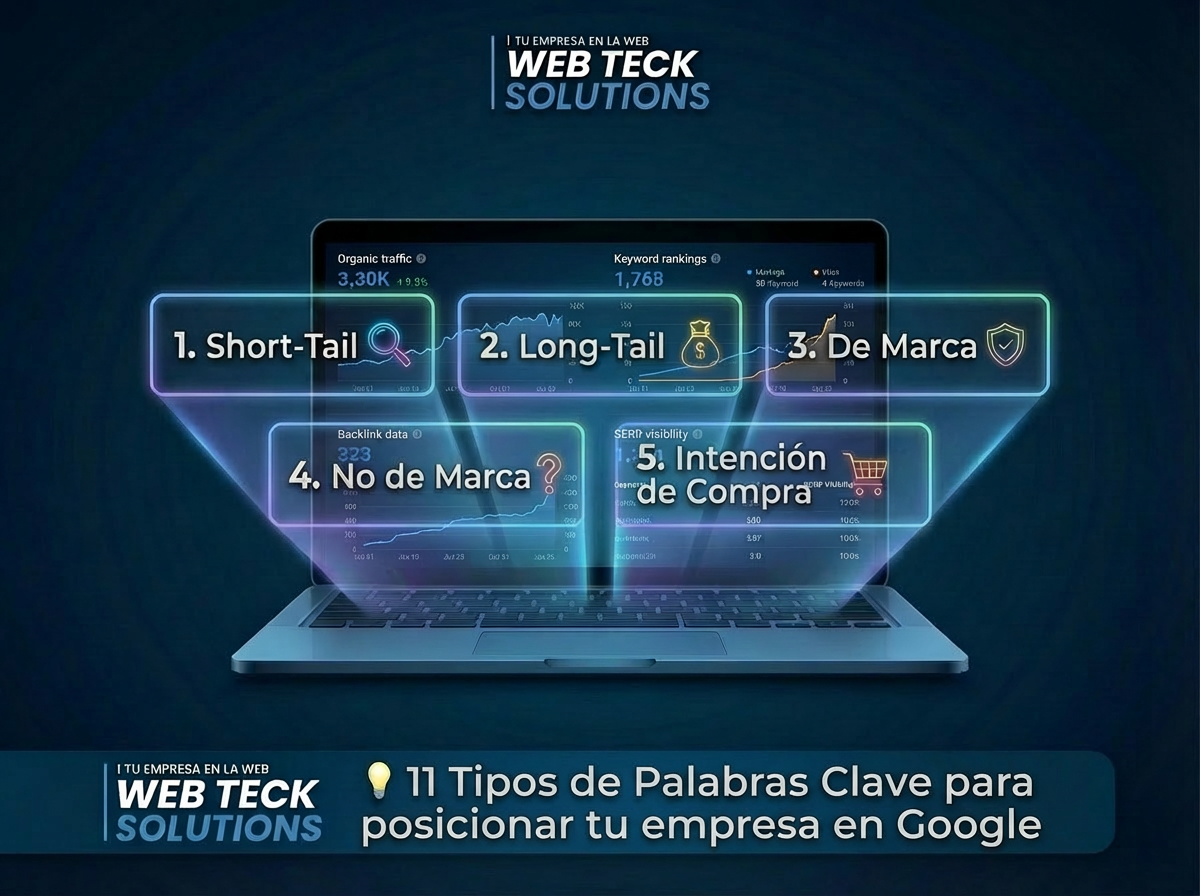
1. “Short-Tail” Keywords (Short Tail)
These are one or two word terms. They are very general and have a lot of competition.
- Example: “Shoes,” “Marketing,” “Houses.”
- Are they useful? For brand building, yes. But for an SME, competing here is costly and difficult. Generally, someone who searches “Shoes” is just browsing photos, not buying.
2. “Long-Tail” Keywords (Long Tail)
This is where the money is. These are phrases of 3 or more words, much more specific. They have fewer monthly searches, but the conversion rate (sales) is very high.
- Example: “Formal leather shoes for men in Bogotá” or “Apartment for rent in Chapinero Alto with terrace.”
- The Benefit: The user who types this knows exactly what they want. If you have it, the sale is almost certain.
By Relationship to Your Brand
3. Brand Keywords (Branded)
These are searches that include your company name.
- Example: “Web Teck Solutions Pricing” or “Adidas Sneakers.”
- Importance: You must dominate these searches. If someone searches for your name and your competitor appears first, you’re losing clients who already knew you.
4. “Non-Brand” Keywords (Non-Branded)
Terms related to what you do, without mentioning your name.
- Example: “Best web design agency in Colombia.”
- Importance: They are vital for attracting new clients who have a need but don’t yet know your company exists.
By User Intent (The Decisive Factor)
5. Purchase Intent Keywords (Buyer Intent)
The user is in the commercial research stage. They know they’re going to buy, but they’re deciding which option is best.
- Example: “Best mid-range smartphone 2025,” “Hosting vs VPS comparison.”
6. Informational Keywords
The user has a question or problem and doesn’t necessarily want to buy (yet).
- Example: “How to file taxes in Colombia?” or “Why is my website slow?”
- Strategy: This is where your Blog comes in. If you answer their questions with valuable content, you earn their trust. When they need to hire an accountant or web developer, they’ll look for you.
7. Navigational Keywords
The user wants to go to a specific page of a website.
- Example: “Web Teck Solutions contact” or “Bancolombia virtual branch for individuals.”
8. Transactional Keywords
These are the most valuable. The user has their credit card in hand and is ready for action.
- Example: “Buy SOAT online,” “Order sushi delivery,” “Hire SEO service.”
- Strategy: These keywords should direct to your sales pages (Landing Pages) or product listings, never to the home page or blog.
Advanced Strategies
9. Geo-Localized Keywords
For local businesses in Colombia, these are mandatory. They help Google show you to people near you.
- Example: “Italian restaurant in Parque de la 93,” “Hardware store in downtown Medellín.”
- Tip: Combining this with your Google Maps profile is an infallible strategy.
10. LSI Keywords (Semantic / Context)
These are synonyms and related terms that help Google understand what your content is about. Repeating a keyword a thousand times is no longer enough.
- Example: If your keyword is “Cars,” your LSI terms would be “Automobiles,” “Vehicles,” “Dealership,” “Engine.” This confirms to Google that your content is relevant and complete.
11. Competitor Keywords
A bold but effective strategy. It involves trying to appear when someone searches for your competitors or similar products.
- Example: “Alternative to Webflow” (if you’re a web developer) or “Pricing [Name of Your Competitor].”
Conclusion: Don’t Guess, Plan.
Success on Google is not luck; it’s strategy. A successful SEO campaign is not based on a single type of keyword, but on an intelligent mix of all the above:
- Informational to attract them to your blog.
- Geo-localized so they find you in your city.
- Transactional and Long-Tail to close the sale.
At Web Teck Solutions, we don’t just design beautiful websites; we design content structures based on how your real clients search.
Want us to analyze how they’re searching for you (and if they’re finding you)?
📩 Write to us and let’s start positioning your company today
 +573142062748
 Facebook
 Instagram
 Linkedin